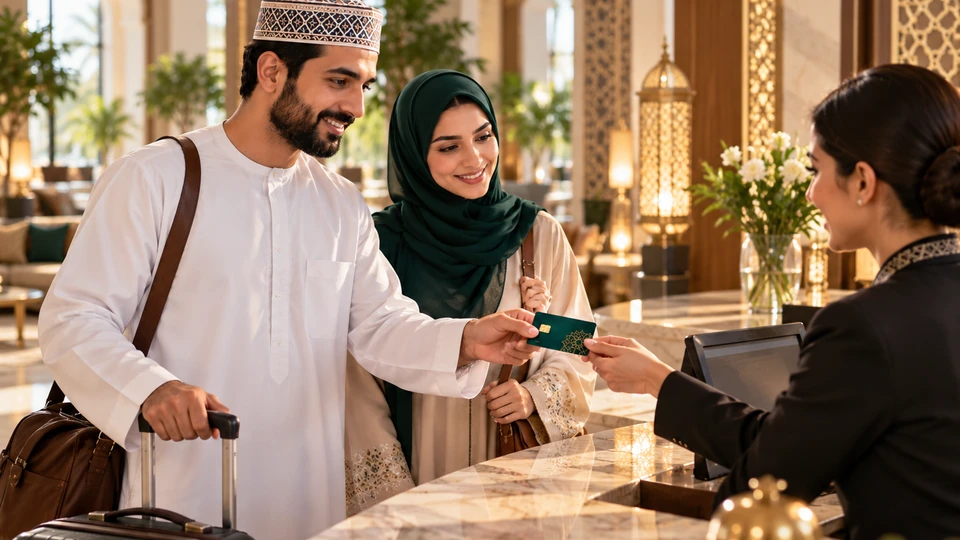
Oman has a relatively young but organised Islamic banking sector, in which fully Islamic banks and the Islamic windows of conventional banks operate under the Central Bank of Oman. A Sharia-compliant card is therefore plausible, though availability, structure and eligibility depend on the institution and should be confirmed with it directly.
The Omani story is one of deliberate, recent growth. Islamic banking was formally introduced in the early 2010s, which means the market has fewer legacy products than neighbouring Gulf states and many offers are still being refined. For a cardholder this has one practical consequence: read each product's contract as if it were new, because it may be.
How Islamic finance entered the Omani market
The Omani rial (OMR) is divided into 1,000 baisa, so prices often show three decimals, and it has long been pegged to the US dollar. Card use is common in Muscat and other towns, and many residents mix debit cards, credit cards and cash depending on the shop.
Two routes to Islamic banking
Islamic banking in Oman developed through standalone Islamic banks and through Islamic windows opened by conventional lenders. Bank Nizwa and Alizz Islamic Bank are examples of the first route, while Bank Muscat's Meethaq and the Islamic window of National Bank of Oman are examples of the second. These names illustrate the market and are not endorsements.
A Sharia framework with a central body
The Central Bank of Oman supervises the sector, and the regulatory arrangements include a higher-level Sharia supervisory body in addition to each institution's own board. The precise powers and the latest rules should be confirmed with the central bank. For the cardholder, the point is that a compliant product should carry an approval that can be named.
Why windows deserve a question
A window is part of a conventional bank. Ask how its Islamic funds and income are separated from interest-bearing activities, because that separation is central to how its Sharia board judges the product.
What to expect from the cards themselves
The table gives a reading grid for the kinds of structures a customer might encounter. Treat it as a checklist, not as a catalogue of what each Omani bank sells today.
| Structure | How it works | Point to check |
|---|---|---|
| Charge card | Spend during the month, settle the full amount at the due date | Late-payment charge and its destination |
| Wakalah-based card | The bank acts as your agent in paying merchants, for an agreed fee | Fee agreed upfront, not growing with the debt |
| Murabaha on a purchase | The bank buys goods and resells them to you on deferred payment | Fixed total price and genuine ownership |
| Debit or prepaid card | Spending limited to your balance | Overdraft features and fees |
Example only: for a 600 OMR laptop sold by murabaha, a bank might quote a total of 636 OMR over twelve months, or 53 OMR a month. The 36 OMR difference is agreed at signature and stays fixed. If a later late-payment charge appears, the contract should say how it is calculated and where it goes.
Applying: a practical sequence
- Work out whether you need a card, a small financing line or a single-purchase murabaha.
- Shortlist a fully Islamic bank and one Islamic window, and ask each for its terms in writing.
- Gather your resident card, passport or ID, salary certificate and recent statements.
- Identify the contract name, the fee schedule and the Sharia approval.
- Compare annual fee, foreign-currency conversion and cash-withdrawal conditions in OMR.
- Check the clause on late settlement and on early repayment.
- After approval, set a spending alert below your limit and pay in full.
Banks use their own credit and risk criteria, and approval is not guaranteed. A salary paid into the bank, a stable employer and a clean repayment record generally help.
Compliance debates to keep in mind
Several questions come up in Oman as elsewhere. They are not unique to the country, but they affect every card you consider.
Instalments, tawarruq and organised structures
Instalment offers on a card may rely on murabaha, tawarruq or a fee model. Many Sharia boards accept some of these while some scholars object to organised tawarruq. Ask which is used and what the total price will be.
Fees versus profit
A fixed fee for a real service is easier to defend than a charge that grows with the amount owed. Pricing that varies with balance and time deserves a closer look at the contract.
Rewards
Points and miles are often funded by interchange paid by merchants. Check exclusions, for example spending at prohibited merchants, and whether some rewards require a financing product you do not want.
Frequent errors and reasons for refusal
Customers often compare cards by headline fee alone. A lower annual fee can hide higher foreign-currency charges, and a no-fee first year can be followed by a standard fee. Calculate the cost for a typical year of your own spending.
Refusals tend to follow short employment history, low salary relative to existing commitments, or incomplete documents. Ask the bank what criterion applied, then correct it. Applying to several banks in quick succession is rarely helpful.
Halal alternatives to consider
If a card is unavailable or unsuitable, a debit card on an Islamic current account is the cleanest route. A prepaid card helps online. Murabaha financing, offered by Islamic banks and windows, is the structured alternative for expensive purchases. Saving first and paying cash keeps costs transparent. For travel, check what the issuer charges abroad before you leave.
After the card arrives
Do not simply activate the card. Compare what you received with what you were promised: the contract name on the agreement, the written fees and the limit. If anything differs, write to the bank before the first use, since corrections are easier early.
Reading the first statement
Check whether any fee appears that was not disclosed, and whether foreign purchases were converted at a reasonable rate. Example: a monthly spend of 120 OMR on subscriptions and groceries, settled in full, costs only the annual fee.
Keep your records
Keep a copy of the contract and notices. They are your reference if you need to contact the bank or the regulator.
Frequently asked questions
Are there fully Islamic banks in Oman? Yes, several, alongside Islamic windows of conventional banks. Whether a particular one offers a card to your profile must be confirmed with it.
Is an Islamic window as acceptable as an Islamic bank? It can be, if its products are approved by a Sharia board and its funds are separated. Ask the window how this is done.
Can an expatriate in Oman get an Islamic card? Often possible with a residence card and salary documents, subject to bank policy. Ask for the exact document list.
Do Islamic cards in Oman charge interest? They should not. You may see fees or profit-based pricing instead, so request the full annual cost in rials.
Who decides what is permissible? The issuer's Sharia supervisory board and qualified scholars. This guide gives general information and is not a ruling.