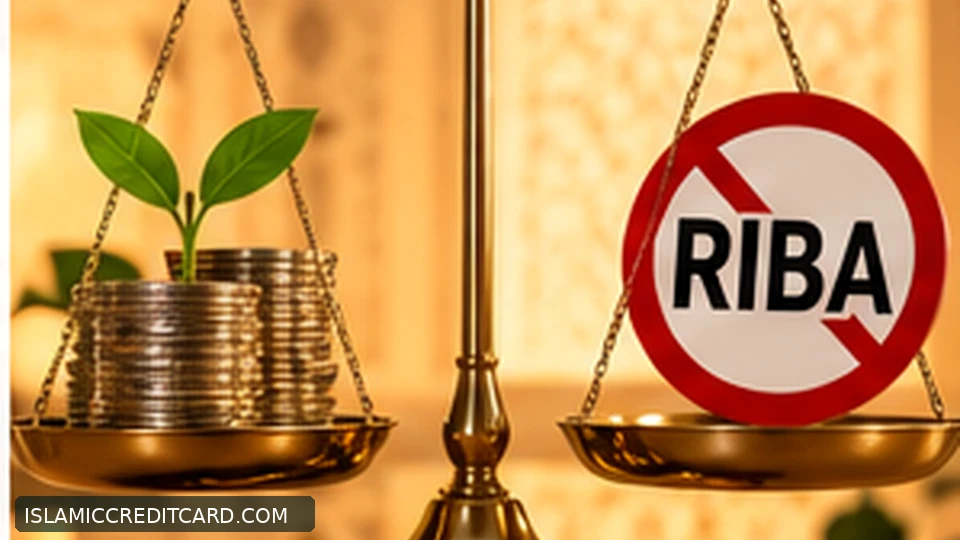
An interest-based instalment on a credit card is a plan that turns a purchase, or part of a statement, into fixed monthly payments while adding a percentage charge for the time taken to repay. From a Sharia perspective the problem is the added charge: money lent today comes back as more money later, which is riba al-nasi'a, the increase paid for deferral of a debt.
These plans are marketed as convenient and "budget friendly", and many are labelled "easy payments", "flexi-pay" or "0% for the first months". The label hides the contract. This guide takes one narrow angle: how a monthly instalment plan is priced, why the flat-rate arithmetic misleads, and which halal instalment structures exist in its place.
How a conventional card instalment plan is built
The cardholder buys an item, then asks the issuer to convert the amount into equal payments over, say, 6, 12 or 24 months. The issuer pays the merchant in full, books a loan to the customer and charges either an interest rate, a flat monthly percentage or a one-off "plan fee" that is really interest in disguise.
Flat rate versus reducing balance
Example (illustrative only): a laptop costs 1,200. The plan charges a flat 1% per month for 12 months. Interest is 1% of 1,200, that is 12 per month, so the total is 1,200 plus 144 and each instalment is 112. It looks like 12% a year, but you repay principal every month, so the true yearly rate is nearly double.
The "fee" that behaves like a rate
Some issuers show a single processing fee of 4% instead of a rate. On 1,200 that is 48, added to the instalments. The fee grows with the amount and the number of months, and it is waived if the customer takes the shortest plan, which shows that it is a price for time and not a payment for a service.
Why the label does not change the ruling
Scholars judge substance over wording. If the charge is proportional to the amount financed and the duration, and the issuer lends money instead of selling goods, most Sharia boards treat it as riba whatever the brochure calls it.
Why Sharia scholars object to it
There are three recurring objections. First, the contract is a loan of money at a premium, so the lender earns a return without bearing the risk of ownership. Second, the issuer never owned the laptop, it only paid the merchant on the customer's behalf. Third, the customer who defaults faces penalties on top of the premium.
Some modern commentators argue that a clearly disclosed instalment mark-up resembles a deferred sale price, which is allowed. Most scholars reply that this only works when the seller of the goods sets the price in one agreed figure, before the contract, and the price does not change if the buyer pays early or late. A card plan priced per month fails that test.
The same purchase under three structures
The table compares one 1,200 purchase repaid over 12 months. All numbers are examples chosen to show mechanics, not real offers.
| Structure | What the customer owes | Contract nature | Main Sharia concern |
|---|---|---|---|
| Conventional flat-rate plan | 1,344 in 12 payments of 112 | Loan with interest | Riba al-nasi'a |
| Reducing-balance APR plan | About 1,290 depending on rate | Loan with interest | Riba, with interest on interest if a payment is missed |
| Instalment sale (bay' bi-taqsit) | 1,320 fixed, agreed before signing | Sale of goods | Seller must own the goods; no increase for lateness |
| Murabaha with a bank | 1,320 fixed, bank buys then sells | Cost-plus sale | Genuine purchase by the bank; scholars differ on card use |
The halal counter-structure
The Islamic alternative replaces a loan with a sale. The financier buys the goods, takes ownership and risk, then sells them to the customer for a price agreed once and payable in instalments. The price may be higher than a cash price, but it is a single known figure and it never grows afterwards.
What a compliant instalment looks like
Many Islamic issuers apply a murabaha or a qard plus a fixed service fee. In the first, the bank states its cost and its profit as a lump sum. In the second, the customer receives an interest-free loan and pays an ujrah for real services, set in advance and not linked to the amount lent or the number of days.
Questions to ask before accepting
Ask who owns the goods at the time of sale, whether the total price is written as one amount, what happens if you settle early, and whether the late-payment clause is a charge that grows with time. A rebate for early settlement is welcomed by many boards, but only if it is not contractually promised.
How to check a plan step by step
- Find the "instalment" or "easy pay" clause in the card agreement and read the pricing paragraph.
- Note whether the cost is a rate, a monthly percentage, or a fee, and whether it depends on the number of months.
- Calculate the total of all instalments and subtract the purchase price.
- Check whether the issuer, or the merchant, is the seller of the goods.
- Read the default clause for any increase of the balance, penalties or rate changes.
- Ask the issuer's Sharia supervisory board contact for the approval document of the plan.
- If any answer is unclear, pay the full amount from your own funds or choose an Islamic plan.
Common mistakes and how to avoid them
The first mistake is trusting the words "0%" or "profit". A zero-rate offer can still carry a fee, a loss of the grace period on other purchases or a rate that starts retroactively if one instalment is missed. The second is splitting a purchase into instalments "just this once": the contract is the same whatever the amount.
The third mistake is assuming that a merchant plan is safer than a bank plan. When a shop offers instalments through a finance partner, the partner usually lends the money and charges interest. A cash discount at the till can be a better solution than any plan, because a discount for early payment between buyer and seller is a different matter from a loan.
If you already signed one
Do not panic and do not stop paying. Contact the issuer, ask about early settlement, and compare the saving with the cost of finding the money elsewhere. Many scholars advise to repay the principal as quickly as possible and to donate the interest part, without expecting a reward for it, while seeking guidance from a qualified scholar.
Budget view: planning without a plan
Example: a household wants to buy a 900 washing machine. By setting aside 150 a month for six months in a savings account that pays nothing, it owns the machine debt-free in half a year. An instalment plan would deliver the machine today but add roughly 50 to 70 in charges, plus the risk of late fees.
A charge card or a prepaid card used for the same purchase gives a middle path: you pay in full when the statement arrives, so no financing is involved. Where speed matters, a murabaha instalment from an Islamic bank is the structure designed for the situation.
Frequently asked questions
Is a 0% instalment plan always halal? Not automatically. If there is no charge at all and the price equals the cash price, the plan is a simple deferral. Check for processing fees, loss of the grace period, penalties and the merchant relationship, and confirm with the issuer's Sharia board.
Is paying a higher price in instalments allowed? Many scholars allow a seller to quote a higher fixed price for deferred payment if it is agreed before the contract and does not change. They do not allow a price that increases per month or per delay.
Can I use a conventional plan if I pay it off early? The contract is still a loan with a premium, and early settlement may not remove the fee. The safest course is to avoid it and use a compliant alternative.
What if my employer or a shop only offers this plan? Ask for a cash price, a different payment method or a murabaha purchase through an Islamic bank. Necessity is judged case by case by a qualified scholar, not by the buyer alone.
Do I need a card to buy in instalments halal? No. A direct instalment sale between you and the seller, or an Islamic bank murabaha, needs no credit card at all.